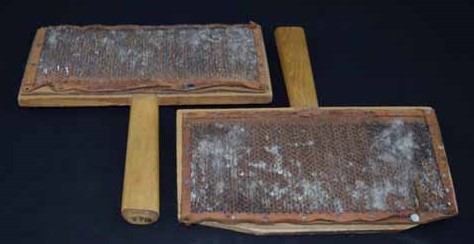
Christmas ‘carding’ was and continues to be a common pastime amongst textile enthusiasts. Intended to separate, remove impurities, and align wool into parallel fibres, hand carders untangle fibrous materials including silk, cotton, wool, and fur. This set of carders was made by Andrew Sjorlund circa 1900, who used hardwood and numerous nails secured by leather, which was characteristic of the carding tool design at the time. Early carders, prior to the 18th century, were made of thistles with hooked points called Fuller’s Teasels. One of the earliest mechanical devices was invented in 1738 by Lewis Paul that configured 16 carders mounted on a board with a single card held in hand to perform the pull operation. Typically, carding was completed by children during an age when the fireplace took on the role of the television! The task is simple, you spread the wool on one card and the second card drags across it while pulling both in the opposite direction, all in preparation for spinning and weaving. So, if your curiosity compels you to either watch or participate in carding or other wooly festivities, don’t be sheepish and join the Heritage Museum this Saturday for Knit Happens.
Wetaskiwin District Heritage Museum Centre & City of Wetaskiwin Archives
an inclusive gathering place for the local community to engage in the history, heritage and culture of Wetaskiwin City, County, and the Maskwacis Cree Four Nations
Menu
The shop on this website is for society related items such as memberships and fundraisers. To shop our Star Store Gift Shop please visit starstoreonline.com
The Art of Christmas Carding: A Textile Tradition