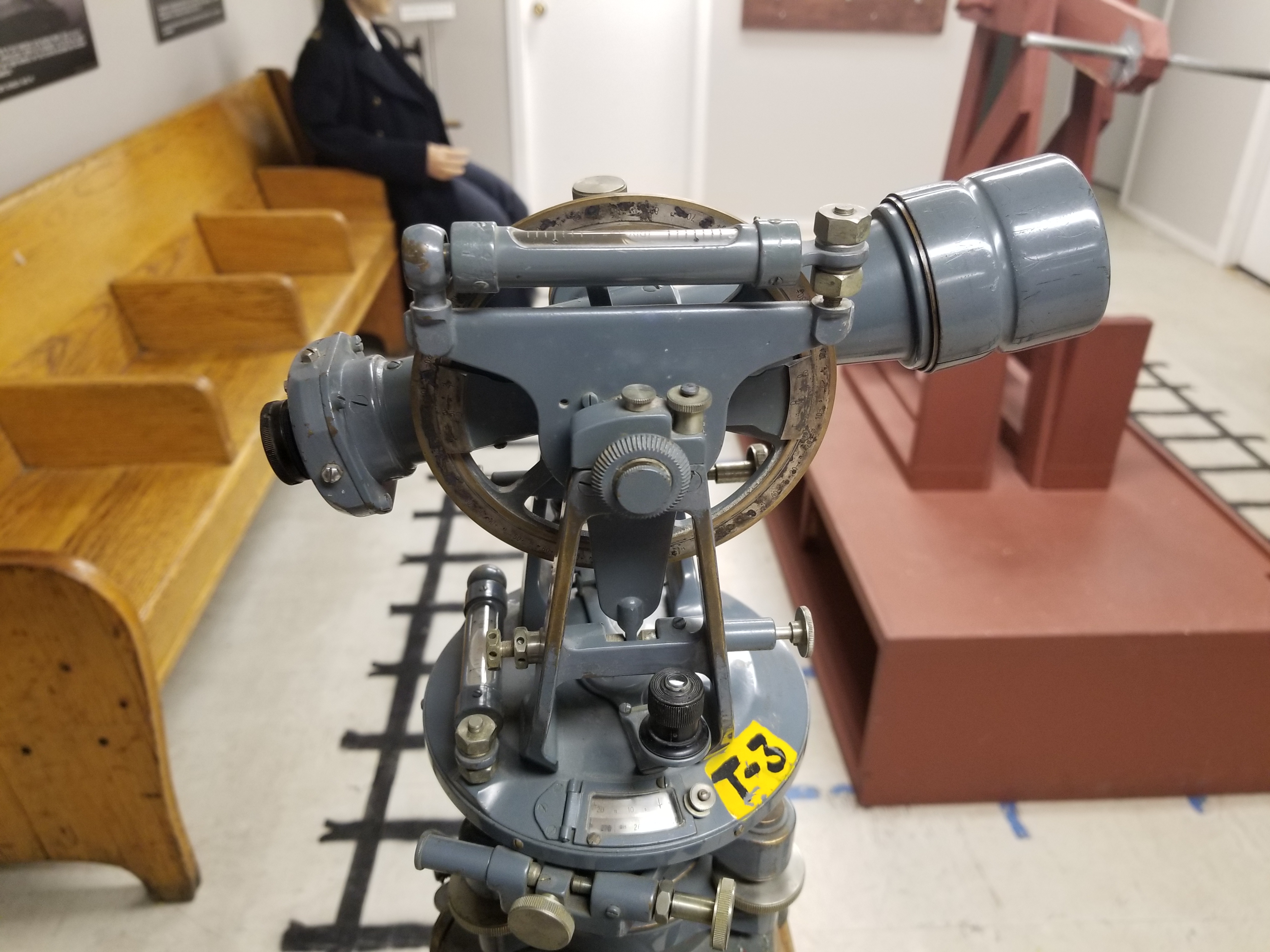


This artefact was most generally used in the early 1900s by surveyors and civil engineers for measuring angles, determining distance and direction, and doing levelling. The chief parts of the transit are two circular plates, a and b, usually of brass or copper and mounted independently upon the same axis so that the upper plate will revolve upon the lower. Supports, c, are attached to the upper plate to support the telescope d, which moves up in a horizontal axis. The level, e, is attached to the telescope, and a graduated vertical circle, f, is attached to the axis. Beneath the telescope is a magnetic needle, g, which moves over a dial graduated in degrees, minutes and seconds. Devices called verniers, which allow a finer setting of transit, are also attached to both the horizontal and vertical scales so that the slightest movements can easily be read. There are numerous other screws and lines for adjustment. The entire apparatus is attached by a toggle joint to a brass plate, h, which is fastened to the tripod.