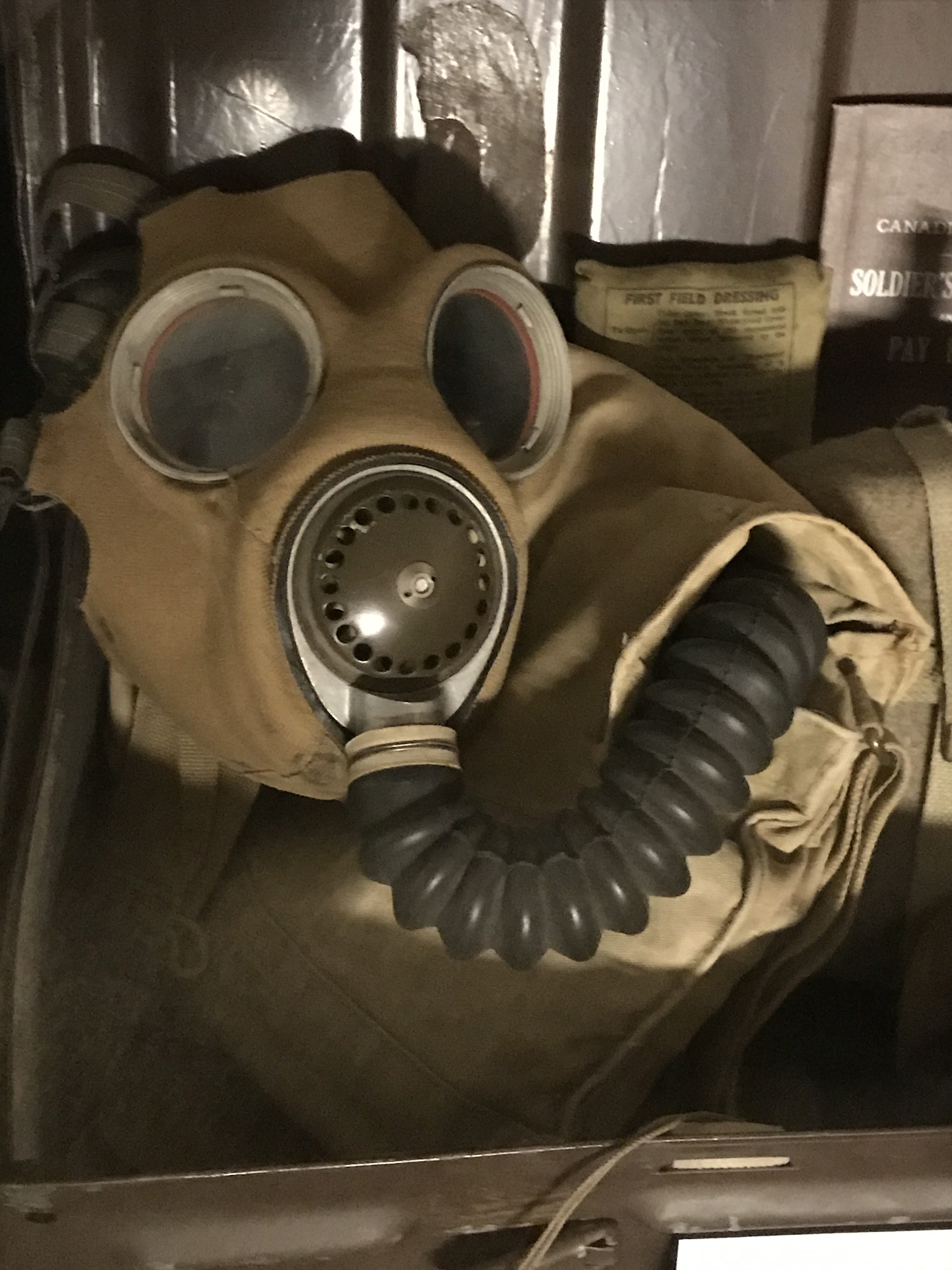
Remembering those who have experienced the traumas of war and those that will never return, we continue this week’s Heritage Moment discussing gas masks. Prior to the Battle of Ypres, 18,000 gas shells filled with xylyl bromide targeted Russian lines over Bolimow in January of 1915. This early form of tear gas was a failure largely due to the cold front cast in the wake of the shells being released. However, by April that year, the British media lambasted the Germans for their chlorine gas devices that covered the fields in ghostly greens clouds at the second Battle of Ypres. These weapons were termed as ‘cold-blooded’ and ‘uncivilized’, yet it did not prevent the British from attacking the Germans with gas at the Battle of Loos four months later. Salvation Army workers recall soldiers having sneezing attacks, blindness, blisters, gradual asphyxiation and in many cases, they would choke to death. The fabric smoke helmet was made to reduce these side effects which was introduced by Canadian, Cluny Macpherson. He designed a single exhaling tube that came with chemical sorbents as defense against airborne chlorine. Both the Allies and the Germans later added air filter drums that contained neutralizing gas chemicals to the respirators called the Small Box Respirator or SBR (like the one shown here), making it the most prominently carried mask. Sadly, mustard gas became the most widely deployed, rendering the gas masks virtually useless when the wool uniforms became soaked in the toxin causing blisters externally and internally. Gongs were the signature signal for gas alerts where troops were often crippled by the horror of the impending elusive ‘phantom threat.’ At the end of WWI over 90,000 soldiers from all sides were reportedly killed by gas and over 185,000 British and Service personnel were classed as gas casualties. Even though the machine gun and the flamethrower were statistically more lethal on the battlefield, chemical weapons were outlawed by the Geneva Protocol in 1925.
Wetaskiwin District Heritage Museum Centre & City of Wetaskiwin Archives
an inclusive gathering place for the local community to engage in the history, heritage and culture of Wetaskiwin City, County, and the Maskwacis Cree Four Nations
Menu
The shop on this website is for society related items such as memberships and fundraisers. To shop our Star Store Gift Shop please visit starstoreonline.com
The Impact of Chemical Warfare in WWI